
There are certain moments in our work that stay etched in our memory… and unfortunately, not all of them are happy ones. Do you remember that cold sweat running down your back when you hear that faint “click”? The sound of a file separation inside a narrow, curved canal… that feeling that the world just stood still for a second. We have all been there, or at least we dread it like a nightmare.
Now, imagine with me… what if, before inserting your file into that canal, you had a way to test it on an exact replica of the tooth? You would know exactly how much stress it can handle, and where and when it would break. Imagine having a super-precise “GPS” telling you the location of a Calcified Canal to the millimeter without drilling unnecessarily and weakening the tooth.
Until recently, this was closer to science fiction, but today it is starting to become a tangible reality known as “Digital Twin” technology. A new research paper opens a window into this exciting future, telling us how this tech could completely change the face of root canal treatment.
Let’s see, Doctor, how this sci-fi is becoming reality inside our clinics.
1. What does “Digital Twin” actually mean?
Before diving into details, let’s simplify the concept. A Digital Twin, Doctor, is simply a Virtual Replica—an exact copy of a real object, with its data updated moment by moment.
A non-medical example to clear the picture: Airline companies use it. They create a full digital version of a real plane engine. This version connects to sensors on the original engine, telling them exactly the engine’s status, when it needs maintenance, and even predicting if a part is about to fail.
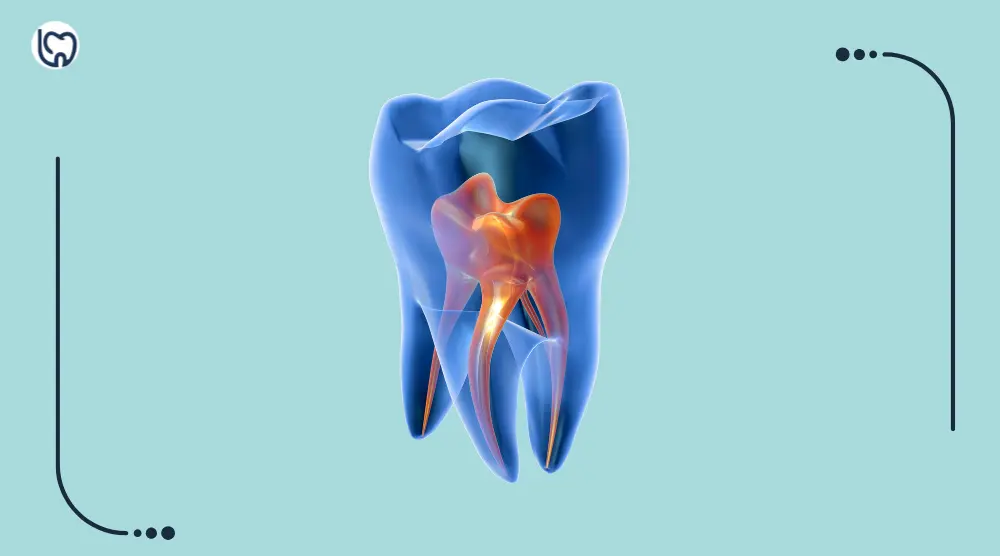
In our case: The Digital Twin is a virtual version of the patient’s tooth and surrounding tissues, built on very accurate real data (like CBCT), and it interacts exactly as if it were the real tooth.
This idea is starting to enter dentistry, especially Endodontics, to shift our work from just reacting to problems to being proactive and planned with extreme precision.
2. Current Applications: How is it used now in Endodontics?
The research summarized the 4 most promising and exciting uses for the Digital Twin, and all of them touch on sensitive points in our daily work:
A. Monitoring files moment-by-moment to prevent breakage!
This is perhaps the application that matters most to us. Our biggest nightmare is that “click” sound of a file breaking inside the canal.
What happens? A research team (Ruffa et al., 2023) created a digital twin for NiTi Files. Using Infrared Thermography, this digital twin can monitor the stress and heat on the real file while it is working inside the canal.
The bottom line here? This system works like an “early warning device.” Before the file reaches the danger zone and breaks, the system gives you a warning, so you can change the file and continue safely. This is really high-level stuff!
B. Precise planning on an exact 3D replica of the case!
We all use CBCT to see complex canal anatomy. But the Digital Twin takes this to a whole new level.
What happens? Using CBCT data, we can create a 3D anatomical model of the tooth with sub-millimeter accuracy (Lee et al., 2023).
What’s the difference? The difference is that this isn’t just a picture we watch. It is a model we can “interact” with. We can rotate it, peel away layers, measure dimensions, and plan the best Access Cavity and the best path for the files, especially in difficult cases with unusual anatomy. This makes you enter the case knowing it by heart.
C. Training new doctors on “virtual” cases as if they were real.
Who among us didn’t learn on extracted teeth? But imagine learning on an exact digital copy of a complex real case, and being able to redo the work 100 times with zero risk.
What happens? Simulation Platforms built on the Digital Twin are used to train dental students and new doctors, for example, on Regenerative Endodontics cases (Hu et al., 2025).
The benefit? It provides a very safe learning environment, increases competence, and lets the doctor make mistakes and learn freely without any harm to a real patient.
D. Treating Calcified Canals with a “GPS” specially made for the case!
Calcified canals are a headache for any dentist. The cavity we create to reach them might weaken the tooth or even cause a Perforation.
What happens? Systems like PriciGuide™ have appeared, using Digital Twin data to design a Surgical Guide specific to each case. This guide fits onto the tooth and directs your hand to the millimeter to reach the calcified canal via the shortest and most accurate path possible.
The result? Higher accuracy and better preservation of sound tooth structure.
3. So, what’s the catch? Why aren’t we using it tomorrow morning in our clinics?
After all this beautiful talk, we have to be realistic. The paper was very frank in presenting the challenges and obstacles keeping this tech far from daily use:
-
Still in the infancy stage: Most research done is still preliminary, on small samples, and in a single research center. There are no large Multicenter Trials to prove its effectiveness on the ground yet.
-
High Cost: The hardware and software required to create a digital twin are still very expensive, and there are no studies confirming if this cost has a clear economic return (Cost-Effectiveness) for the clinic.
-
No Unified Protocol: Every research team works their own way. There are no Standardized Protocols for collecting data, building the digital model, or using it clinically.
-
Need for Training: This technology requires specialized training to use correctly.
-
Ethical and Legal Aspects: Who is responsible if an error occurs based on a Digital Twin recommendation? How do we protect this precise patient data? These are very important questions that need answers.
The Summary and the “Bottom Line” for you in the clinic, Doctor:
-
Will Digital Twin technology change our root canal work tomorrow morning? No, of course not.
-
But does it represent a very important glimpse into the future of the profession? Definitely yes.
-
The Bigger Picture: This technology is a giant step toward Personalized Medicine in root canal treatment. Every patient will have a treatment plan tailored to their exact measurements.
-
Huge Potential: Its potential in increasing diagnostic accuracy, raising safety levels during treatment (especially with files), and developing medical education cannot be denied.
-
The Road is Still Long: The topic needs much more research, collaboration between doctors, researchers, and companies, and the development of solutions that are user-friendly and affordable.
-
Keep an Eye on It: As advice from a colleague to a colleague, stay updated on developments in this field. Read about it from time to time, because what we consider complex, futuristic technology today could very well be the essential device in your clinic a few years from now.
This is the future knocking on our doors, Doctor… a future where root canal treatment could be much more precise, safer, and enjoyable than what we know today.


